


IntelliStage® Lightweight Portable Stage Comparison
IntelliStage Lightweight vs Accordion & X-Riser Portable Stages
Why the Original IntelliStage Lightweight System Remains the Engineered Standard
Compare the Complete Stage System—not One Marketing Claim
Lightweight modular stages with collapsible accordion or expandable X-riser bases now appear across Amazon, Walmart, Wayfair and other online marketplaces. Many closely resemble the original IntelliStage® lightweight modular stage design that we developed and brought to market more than 25 years ago.
Similar-looking portable stages have never been easier to find online—and they have also never been harder to properly evaluate.
These products may be described as portable stage platforms, folding stage platforms, modular folding stages, portable stage risers, accordion X-riser stages, expandable riser stages or centipede-riser stages. These labels describe the general product category. They do not establish that the products share the same construction, internal engineering, structural rigidity, testing or long-term support.
This comparison examines common features and claims such as deep-nest perimeter designs, accordion risers, X-risers, perimeter support, secure connections and compact nesting.
Imitation may be flattering, but proven performance is earned.
For more than 25 years, IntelliStage® has engineered lightweight modular staging around the complete assembled structure:
-
An engineered multilayer platform
-
A proprietary internal honeycomb load-distribution grid
-
A structurally integrated aluminum frame
-
4 INTERNAL Cam LOCKS. 9 REINFORCED SUPPORT POINTS for SUPERIOR STABILITY.
-
Documented professional load capacity
-
Physical applied-weight testing with measured platform deflection
-
Long-term replacement parts and manufacturer support
Marketplace listings and current competitive product pages use terms such as tool-free, clip-lock, snap-lock, quick-connect, “SecureLock” connection, “Deep NEST Perimeter Design”, nested riser, nine points of engagement, blind disassembly, field-replaceable hardware, expandable X-riser bases and approximately one minute per panel.
These terms may describe a convenient feature. They do not, by themselves, establish the stage systems strength, rigidity, deflection, stability, complete setup time, load capacity or durability.
A load bearing structure such as a portable stage should be evaluated as a complete structural system—not by one clip, one photograph or one headline number.
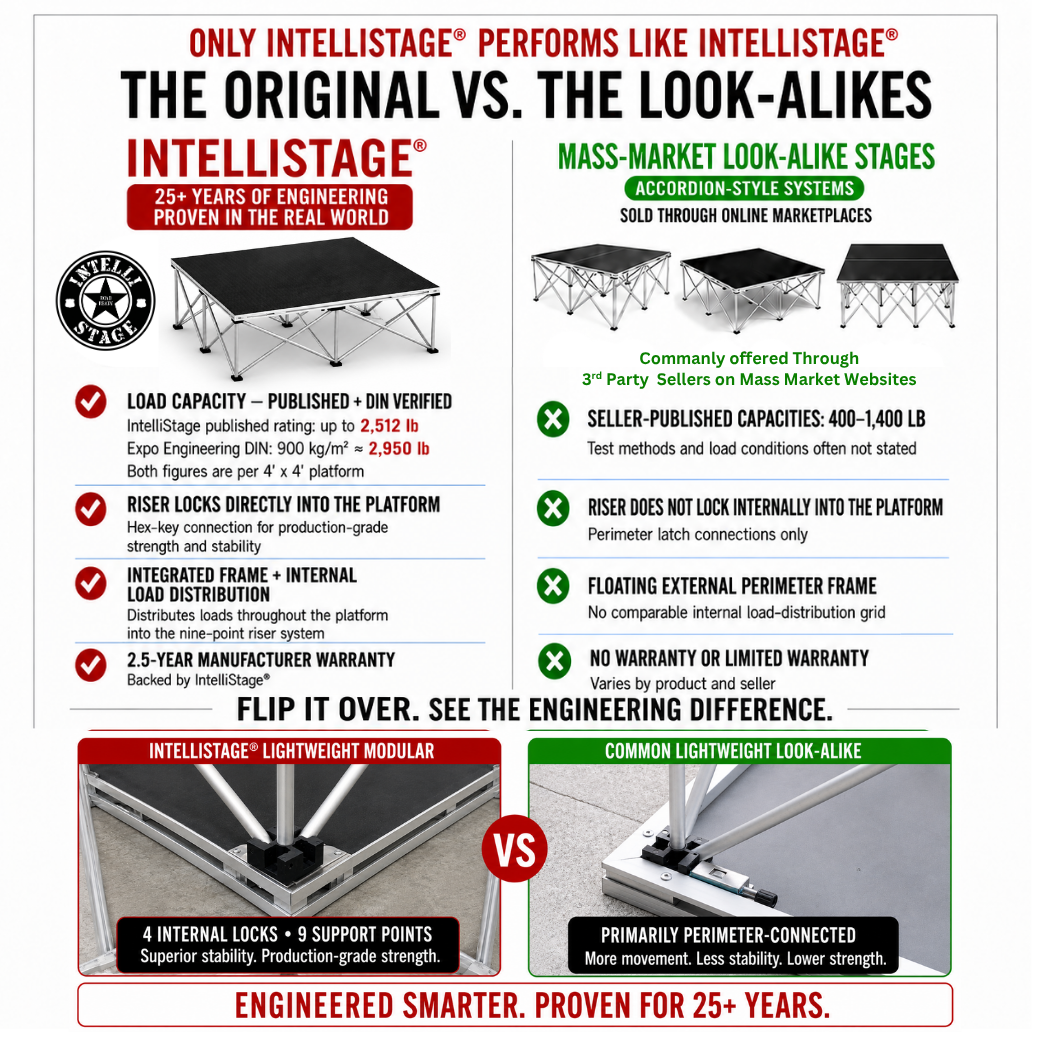

Compare the Engineering Beneath the Platform
A black stage surface and an expandable riser do not reveal how the system is engineered underneath.
The meaningful differences are found in how the platform core, structural frame, supporting riser, center support and adjoining platforms work together as one complete load-bearing system.
Side-by-Side Comparison
Mass-market look-alike information reflects publicly available manufacturer, seller and marketplace information reviewed online in September 2026. Products vary, and buyers should confirm the current construction, documentation, testing, warranty and support available for the exact system being considered.
| Comparison Point | IntelliStage® Lightweight | Common Mass-Market Tool-Free Expandable X-Riser and Accordion-Style Look-Alikes Found Online in 2026 |
|---|---|---|
| Design history and manufacturer accountability | The original IntelliStage Lightweight system was developed and brought to market more than 25 years ago. IntelliStage designs, develops, manufactures and supports complete portable staging systems sold through authorized dealers and international distributors. | Some systems are sold under reseller, importer or private-label names. The original manufacturer, design history, testing responsibility and future parts continuity may not always be clear. Buyers should confirm who designed and manufactured the system—and who will support it after the sale. |
| Platform-to-riser connection | 4 INTERNAL LOCKS. 9 REINFORCED SUPPORT POINTS. SUPERIOR STABILITY. PRODUCTION-GRADE STRENGTH. Male riser inserts engage matching female receivers within the platform frame. Four internal mechanical locks are tightened with a hex key, positively securing the riser into the platform rather than allowing the platform merely to rest on top of it. | PRIMARILY PERIMETER-CONNECTED WITH FOUR LATCHES. MORE MOVEMENT. LESS STABILITY. LOWER CONNECTION STRENGTH. Common designs use a flat riser top with four perimeter or corner latches and no comparable male-to-female engagement within the platform frame. The latches may position or retain the riser, but they do not create the same internally interlocked connection. |
| Internal locking geometry | Male riser inserts positively locate the riser within corresponding receivers in the platform frame. Tightening the four internal locks mechanically secures the two assemblies together and helps restrict vertical separation, lateral movement and rotation at the connection. | A flat-top riser interface relies primarily on surface contact and perimeter retention. Without male inserts engaging matching internal receivers, greater relative movement may occur between the platform and riser—even when the perimeter latches remain connected. |
| Internal load path | The multilayer platform, proprietary honeycomb grid, structurally integrated frame, four internal locks and nine reinforced riser-support points work together to distribute loads across the platform and transfer them vertically through the riser to the floor. | Load paths vary. Flat-top designs may transfer more of the load through the platform perimeter, corner fittings, perimeter latches, angled joints or selected contact points. Buyers should ask the seller to identify the complete structural load path—not merely provide a maximum-capacity number. |
| Platform rigidity and internal core | Engineered multilayer sandwich platform with a proprietary internal honeycomb load-distribution grid. The core distributes loads internally and helps the platform resist bending, bounce and visible deflection. | Many listings describe a lightweight deck or aluminum frame without disclosing an equivalent internal load-distribution core or measured platform deflection. A headline load rating alone does not establish equivalent platform rigidity. |
| Platform frame | Structurally integrated heavy-duty aluminum frame engineered to work with the deck, internal honeycomb grid, internal locks and riser as one assembled structural system with controlled load paths. | Often described primarily as a perimeter aluminum frame. The grade and thickness of the aluminum—and how the perimeter frame is structurally tied into the internal core or center of the platform—may not be disclosed. |
| Riser construction, fit and stability | The nine-point expandable riser is manufactured to maintain its geometry, remain square and resist lateral racking and torsional movement. Male inserts positively locate the riser within the platform frame, while four internal locks secure the connection. This controlled mechanical fit reduces joint play and produces the solid, stable feel expected from a production-grade staging system. | Less-rigid riser construction, looser pivot joints and accumulated manufacturing clearances can permit greater joint play, lateral deflection, torsional twisting and frame racking—the movement users experience as wobble. A flat riser top without positive male-to-female engagement may also permit greater movement between the platform and riser, resulting in less connection rigidity and overall stability. |
| Complete structural assembly | The platform, internal frame, honeycomb load-distribution grid, four internal locks and nine-point riser function as one mechanically connected structural assembly. The riser is not simply placed beneath the platform—it is positively located and internally locked into it. | In primarily perimeter-connected designs, the platform may rest on a flat riser surface and be retained by four external latches. This may hold the components together, but it does not provide the same internal engagement, movement control or connection strength as a four-point internal male-to-female locking system. |
| Platform rigidity and deflection | The multilayer platform, proprietary honeycomb grid, structurally integrated frame and nine reinforced support points work together to resist visible flex, bounce and wobble. | Some thinner or minimally supported platforms visibly flex or wobble more under comparable pressure. Buyers should request measured-deflection information rather than relying only on a maximum-capacity claim. |
| Published load rating | 157 lb/ft²—up to 2,512 pounds uniformly distributed across a properly assembled 4′ × 4′ platform-and-riser system. | Many budget and look-alike listings reviewed online in 2026 advertised approximately 400–1,400 pounds per platform. Some current products advertise higher figures. A number is not directly comparable unless the platform size, load type, complete-system configuration, support placement and test method are disclosed. |
| Engineering and testing evidence | Physical applied-weight testing with measured platform deflection, plus a separate independent engineering calculation of 900 kg/m²—approximately 184 lb/ft²—according to five DIN structural standards. The published IntelliStage system rating remains 157 lb/ft². | Many listings publish a capacity number without providing a readily available complete-system test report, named structural standard or measured-deflection result. Buyers should ask how the rating was established and request the supporting documentation. |
| Comparison Point | IntelliStage® Lightweight | Common Mass-Market Tool-Free Expandable X-Riser and Accordion-Style Look-Alikes Found Online in 2026 |
|---|---|---|
| Materials and component durability | DURABLE POLYMER COMPONENTS DESIGNED TO RESIST CRACKING. HEAVY-DUTY ALUMINUM ENGINEERED FOR CONTROLLED LOAD PATHS. IntelliStage combines structurally integrated aluminum framing, metal load-bearing connection hardware and durable engineered-polymer components selected for repeated professional use. The materials, component geometry and connections are engineered to work together as a complete structural system. Locks, connectors and other compatible components can be inspected, serviced and replaced. | Some systems use plastic fittings, clips or connectors together with lightweight aluminum components. Material grades, aluminum thickness, fatigue performance, crack resistance and the structural role of individual plastic components may not be disclosed. Buyers should determine whether these components are load-bearing, designed for repeated commercial use and replaceable if cracked, damaged or worn. |
| Complete one-panel setup speed | 29-SECOND, ONE-Panel SETUP. FASTER COMPLETE SETUP—POSITIVELY LOCKED. In the side-by-side video demonstration, one person expands the IntelliStage riser directly on the floor, places the platform on top finished-side up and engages the four internal locks from above with a hex key. The complete platform-and-riser assembly is positively locked in 29 seconds without having to lift or flip the assembled module | 45-SECOND, One-panel SETUP. “TOOL-FREE”—BUT NOT FASTER. Closing a perimeter latch may be tool-free, but it is only one step in the complete setup process. In the same demonstration, the platform is positioned upside down, the riser is expanded, aligned and attached underneath using four perimeter latches, and two people then lift and flip the assembled module upright. The complete setup takes 45 seconds—16 seconds longer than IntelliStage. |
| Tool-free convenience versus connection strength | IntelliStage uses a hex key to engage four internal mechanical locks because the objective is positive structural engagement and production-grade connection strength. The complete one-panel setup remains fast without sacrificing the internally locked riser-to-platform connection. | “Tool-free” describes how a clip or latch is operated; it does not establish the strength, rigidity, load path or speed of the complete assembly process. Buyers should compare the finished structural connection—not merely whether one attachment step requires a tool. |
| System versatility | 26 approved platform size, shape and finish combinations, six standard riser heights and 29 finished-height possibilities using compatible standard and stacked-riser configurations. Approved finished heights extend up to 64 inches. | Square platforms and standard heights are widely available, but specialty shapes, surface choices, approved stacking combinations and maximum heights vary. Buyers should confirm every configuration specifically authorized by the manufacturer. |
| Warranty, replacement parts and technical support | 2.5-year manufacturer warranty, U.S.-based technical support and long-term replacement-parts availability through authorized IntelliStage dealers. The system is backed by a staging manufacturer with more than 25 years of product history. | Warranty coverage varies. Some online listings provide limited warranty information or do not clearly identify the responsible manufacturer. Buyers should confirm the written warranty, replacement-parts availability, technical-support provider and who will remain responsible after the sale. |
Comparison note: Mass-market observations were compiled from publicly available manufacturer, seller and marketplace information reviewed in September 2026. Designs, ratings and warranty terms vary by product and may change. The approximately 400–1,400-pound range reflects many budget and look-alike listings reviewed—not every current product. Some products advertise higher capacities. Buyers should compare equivalent platform sizes, complete-system configurations, load types, test methods and written warranty documents.
What Is Inside the Platform—and Why Does It Matter?
Platform Rigidity Starts Inside the Deck
Two portable stage platforms can look nearly identical from above while behaving very differently under pressure.
IntelliStage uses an engineered multilayer sandwich platform with a proprietary internal honeycomb load-distribution grid. The grid distributes loads through the platform instead of leaving the center to span primarily between perimeter supports.
The platform’s multilayer faces, integrated structural frame, internal grid and nine-point riser support work together to resist:
-
Bending
-
Bounce
-
Localized flex
-
Visible platform deflection
-
Movement between the deck and supporting structure
A platform described only as “lightweight” or “aluminum framed” may not disclose what supports the center of the deck, how loads are distributed internally or how much the platform deflects under load.
A high maximum-capacity number does not, by itself, prove that a platform will feel equally rigid beneath a performer.
Video: Is the IntelliStage Platform More Rigid?

The side-by-side demonstration shows the visible difference in platform flex when comparable pressure is applied to the IntelliStage Lightweight platform and the mass-market folding portable stage platform shown.
The IntelliStage multilayer platform, internal honeycomb grid, integrated frame and nine-point support work together to produce a more rigid platform with less visible flex in the comparison.
What this video demonstrates: Visible comparative platform movement and deflection in the specific systems and conditions shown.
What it does not replace: Complete-system load testing, engineering documentation or a standardized laboratory deflection test.
Platform Weight and Platform Rigidity Are Different Measurements
A lighter platform can be easier to lift and carry. That is a legitimate handling advantage.
However, platform weight alone does not establish equivalent:
-
Internal construction
-
Structural rigidity
-
Load capacity
-
Deflection control
-
Durability
-
Long-term performance
Those qualities depend on the complete construction: the face materials, internal core, frame, support spacing, connection hardware and the way the assembled system transfers loads.
IntelliStage platforms are engineered to balance lightweight handling with the rigidity and professional capacity required from a complete modular stage system.
How Does the Riser Actually Connect to the Platform?
Strength and Stability Start at the Platform-to-Riser Connection
One of the most important engineering differences between similar-looking portable stages is how the platform engages with the supporting riser beneath it.
This connection influences:
-
Alignment between the platform and riser
-
Movement between the components
-
Resistance to platform lift and lateral shift
-
How loads are transferred into the supporting structure
-
How the platform, frame and riser behave as one assembled system
IntelliStage uses four internal mechanical locks, operated with a hex key, to positively secure the supporting riser directly to the underside of the platform.
The connection is an intentional structural feature—not merely a positioning clip.
Once engaged, the platform, structurally integrated frame, proprietary honeycomb grid and nine-point riser work together to create a continuous internal load path.
Some similar-looking accordion and expandable X-riser stages connect primarily through edge clips, corner pins, tabs or perimeter hardware. These components may help locate or retain the riser, but buyers should not assume that they provide the same internal structural engagement or load path.
Some current look-alike marketing describes the riser as sitting within a “Deep NEST Perimeter” before a “SecureLock” style perimeter connection is engaged. Nesting may help position the riser, but buyers should still determine whether it is mechanically locked into the internal platform structure and how the completed interface controls lift, lateral movement and rotation.
Safety Through Positive Internal Engagement
The IntelliStage internal locking system is engineered to resist:
-
Platform lift caused by vibration or uneven loading
-
Lateral movement between the platform and riser
-
Unintended disengagement during normal use
-
Progressive looseness through repeated assembly cycles
A system should not be assumed structurally equivalent simply because it uses a collapsible X-frame or has nine visible riser feet.
Video: Does the Riser Lock Into the Platform—or Only Clip Around the Edge?

The close-up demonstration compares IntelliStage’s positive internal platform-to-riser lock with the perimeter clip-style connection shown on the look-alike system.
The IntelliStage connection mechanically draws the riser into the supporting platform structure. In the comparison shown, this creates a stronger and more secure connection than the tool-free perimeter attachment being demonstrated.
What this video demonstrates: The visible engagement and comparative connection strength of the specific platform-to-riser mechanisms shown.
What buyers should ask: Does the connection positively engage the internal platform structure, or does it primarily position and retain the riser around the platform perimeter?
Materials Should Be Selected for Repeated Professional Use
Structural performance depends on material selection as well as overall design.
IntelliStage uses engineered aluminum framing, metal load-bearing connection hardware and durable system components designed for repeated setup, breakdown, transportation and long-term use.
Connection components are also serviceable. Platform-to-riser locks, platform-to-platform cam locks and other compatible components are available as replacement parts through authorized dealers.
A worn or damaged connection should not automatically make an otherwise serviceable platform unusable.
When comparing another system, buyers should ask:
-
What material is used at each load-bearing connection?
-
Are material grades and thicknesses disclosed?
-
Have the components been evaluated for repeated assembly?
-
Can individual clips, locks and connectors be replaced?
-
Will compatible parts remain available in the future?
Does the Expandable Riser Stay Square—or Rack and Twist?
The riser is the structural foundation beneath the platform.
A properly manufactured expandable riser should remain square and aligned as it is opened, positioned and connected. Excessive movement in the open riser can indicate greater joint play or looser connection tolerances.
The IntelliStage nine-point riser is designed to hold its geometry and resist side-to-side racking before and after it is mechanically locked to the platform.
Less-rigid riser construction may permit greater joint play, lateral deflection, twisting and frame racking. Buyers should compare the structural rigidity, connection tolerances and center support of the exact riser being considered.
Video: Rigid IntelliStage Riser vs Loose Look-Alike Expandable X-Riser
When the open risers are handled side by side, the IntelliStage nine-point riser holds its geometry and resists side-to-side racking. The look-alike expandable X-riser shown shifts, twists and moves more loosely.
A riser that remains square and aligned provides a more controlled support structure as the platform is positioned and the four internal IntelliStage locks are engaged.
What this video demonstrates: Relative unloaded riser-frame rigidity, joint movement and side-to-side racking in the specific risers shown.
What it does not replace: Complete-system load-capacity, deflection or safety testing.
Does Tool-Free Really Mean Faster?
No—not Automatically
“Tool-free” describes how one particular connection is operated. It is not a complete setup-time measurement, load rating or strength test.
A tool-free clip may make one assembly step convenient. However, the complete setup process may still require:
-
Positioning the platform upside down
-
Expanding and aligning the riser underneath it
-
Attaching the riser around the perimeter
-
Lifting and flipping the combined platform-and-riser module
-
Moving the module into its final position
-
Aligning adjoining stage platforms
-
Securing the platform-to-platform connections
Some systems promoted as tool-free still require hex-key connectors between adjoining platforms. In those cases, “tool-free” applies only to the platform-to-riser attachment—not the complete stage assembly.
Video: Is the Tool-Free Look-Alike Stage Actually Faster?
Compare the Complete Setup Sequence
| IntelliStage Finished-Side-Up Setup | Flip-Over Expandable X-Riser Setup Shown |
|---|---|
| 1. Expand and position the riser on the floor. | 1. Position the platform upside down. |
| 2. Place the platform finished-side up on top of the riser. | 2. Expand and position the X-riser underneath the inverted platform. |
| 3. Engage the four internal platform-to-riser locks. | 3. Attach the riser using the system’s clips or perimeter hardware. |
| 4. Mechanically connect the platform to adjoining IntelliStage platforms. | 4. Lift and flip the combined platform-and-riser module upright. |
| No assembled module must be lifted and flipped. | 5. Position the module and connect it to adjoining stage platforms. |
A setup-speed claim is only meaningful when both demonstrations use equivalent:
-
Starting positions
-
Floor heights
-
Crew sizes
-
Component placement
-
Platform orientations
-
Finishing points
-
Adjoining-platform connections
A demonstration that begins with an upside-down platform already positioned on a raised work surface is not directly comparable to a setup beginning with the components at floor level.
Recorded Floor-Level Setup Comparison
IntelliStage Lightweight Modular: approximately 29 seconds
The demonstration ends with the platform installed finished-side up and all four internal platform-to-riser locks engaged.
Tool-Free Flip-Over Expandable X-Riser: approximately 45 seconds
The demonstration includes positioning the upside-down platform, attaching the riser underneath and lifting and flipping the combined module.
Recorded result: IntelliStage required approximately 16 fewer seconds—about 36% less time—in the comparable floor-level demonstrations.
The side-by-side video shows the recorded clocks, comparable floor-level starting positions and the complete physical setup sequences.
In the comparison shown, the tool-free flip-over X-riser stage did not set up faster than IntelliStage Lightweight—even though IntelliStage uses four internal hex-key-operated platform-to-riser locks.
Timing note: Times were measured from the supplied demonstrations and rounded to the nearest whole second. These are comparative demonstrations, not standardized laboratory tests. Setup time varies with crew experience, platform finish, stage height, configuration and installation environment.
What Common Marketing Claims Do—and Do Not—Establish
| Marketing Claim | What It Establishes | What It Does Not Establish |
|---|---|---|
| Tool-free connection | No tool is required for that particular connection. | Total setup time, load capacity, platform rigidity, deflection, stability or durability. |
| Lightweight platform | Less weight must be lifted and carried. | Equivalent internal construction, stiffness, load capacity, deflection control or service life. |
| Approximately one minute per panel | A time achieved under the seller’s stated demonstration conditions. | An equal result when floor position, starting point, crew size, platform orientation, finishing point or adjoining-panel connections differ. |
| Published PSF rating | Uniformly distributed capacity under the manufacturer’s stated conditions. | Concentrated point-load capacity, measured deflection or dynamic-load performance unless those conditions were separately tested and documented. |
| Certification or engineering claim | Performance evaluated under the named standard, report and configuration. | Automatic equivalence to a different stage design, test condition, load type or engineering method. |
| Nine riser feet or contact points | The riser appears to have nine points capable of contacting the platform or floor. | Equivalent engagement at all nine points, true center support, equivalent load distribution or the same internal structural connection. |
How Does the Complete Stage Feel Under Real-World Movement?
Published capacity is important, but users also experience how a stage feels when people step onto it, walk across it and move between adjoining platforms.
Platform rigidity, riser engagement, support distribution, adjoining-panel connections and overall structural movement all contribute to that experience.
A stage may support a stated amount of static weight and still exhibit more visible flex, bounce or side-to-side movement than another system.
Video: Which Stage Has Less Wobble and Greater Stability?
The demonstration shows less visible wobble and greater stability in the IntelliStage Lightweight system as the same person steps onto each stage in the same setting.
The result reflects the complete IntelliStage system working together:
-
Proprietary internal honeycomb load-distribution grid
-
Structurally integrated frame
-
Four internal platform-to-riser locks
-
Nine-point support with center engagement
-
Controlled riser geometry
-
Integrated platform-to-platform connections
What this video demonstrates: Visible comparative movement in the specific assembled stages and conditions shown.
What it does not replace: Standardized dynamic testing, engineering documentation or the manufacturer’s instructions for the intended application.
How Should Portable Stage Strength Claims Be Compared?
Strength requires more than a headline capacity number.
A useful comparison must examine the complete assembled platform-and-riser system, including:
-
Platform size
-
Platform construction
-
Support configuration
-
Uniformly distributed versus concentrated loading
-
Physical testing
-
Measured platform deflection
-
Engineering calculations
-
Named standards
-
Intended use and limitations
IntelliStage Documented Performance
-
Published professional rating: 157 lb/ft² for the properly assembled platform-and-riser system
-
4′ × 4′ uniformly distributed capacity: Up to 2,512 pounds across the properly assembled system
-
Physical testing: Applied-weight testing with platform deflection measured
-
Independent engineering calculation: 900 kg/m²—approximately 184 lb/ft²—according to five DIN structural standards
-
Published system rating: 157 lb/ft² remains the stated IntelliStage operating rating
The 2,512-pound figure applies to a properly assembled 4′ × 4′ platform-and-riser system under uniformly distributed loading. It is not a concentrated point-load rating and does not mean that the same weight can be placed at one point on the platform.
Many budget and look-alike listings reviewed online in 2026 advertised capacities of approximately 400–1,400 pounds per platform. Other current systems advertise higher capacities, including claims reaching several thousand pounds.
That is why the number alone cannot answer the question.
Buyers should ask:
-
Does the rating apply to the platform alone or the complete assembled stage system?
-
What platform size was tested?
-
Was the load uniformly distributed or concentrated?
-
Where were the supports positioned?
-
Was the product physically load-tested?
-
Was platform deflection measured?
-
What standard or calculation method was used?
-
Is the full test or engineering documentation available?
More Than a Square Platform and One Riser Height
True modular versatility is more than connecting identical square platforms.
IntelliStage Lightweight provides:
-
26 approved platform size, shape and finish combinations
-
Square and folding-square platforms
-
Equilateral-triangle platforms
-
Right-triangle platforms
-
Quarter-round platforms
-
Compatible step platforms
-
Gray carpet, industrial and Tuff-Coat™ surface options
-
Six standard riser heights: 8″, 12″, 16″, 18″, 24″ and 32″
-
29 finished-height possibilities using approved standard and stacked-riser configurations
-
Approved finished heights extending up to 64″
-
Compatible stairs, guardrails, chair stops, skirts, backdrops, ramps, carts and storage cases
This allows one interchangeable system to create rectangular stages, curved stages, circles, corners, runways, drum risers, camera platforms, multi-height layouts and tiered configurations.
Not every platform shape is available in every finish, and not every platform is compatible with every finished height. An authorized IntelliStage dealer can confirm the correct components and approved configuration.

Long-Term Support Is Part of the Stage System
Portable staging is repeatedly assembled, moved, stored and reconfigured. Over time, connection hardware may require inspection, adjustment, service or replacement.
IntelliStage is supported by:
-
A 2.5-year manufacturer warranty
-
U.S.-based technical support
-
Long-term replacement-parts availability
-
Authorized staging dealers with product knowledge
-
More than 25 years of real-world system history
-
Continued compatibility across platforms, risers and accessories
Before buying a marketplace stage, confirm:
-
Is there a written manufacturer warranty?
-
Who is legally responsible for honoring it?
-
Is the seller also the manufacturer?
-
Are replacement clips, locks, pins and connectors available separately?
-
Can the system be expanded several years from now?
-
Is technical support available from someone familiar with the product?
-
What happens if the original marketplace listing or private-label seller disappears?
The purchase price is only one part of the stage’s long-term value.
Questions to Ask Before Buying Any Accordion or Expandable X-Riser Portable Stage
-
Who designed and manufactures the system?
-
Is the seller the manufacturer, an authorized dealer or a private-label reseller?
-
Does the riser mechanically lock into the internal platform structure?
-
What is inside the platform?
-
How does the internal construction distribute loads?
-
How is the center of the platform supported?
-
How many support points actually engage the underside of the platform?
-
Is the perimeter frame structurally integrated with the deck and internal core?
-
Does the open riser remain square?
-
Does the riser exhibit excessive joint play, racking or twisting?
-
How are adjoining platforms mechanically secured?
-
Does “tool-free” apply to the entire stage or only one connection?
-
Does the setup demonstration begin from a realistic floor-level position?
-
Does the stated time include positioning, lifting, flipping and platform-to-platform connections?
-
Does the published capacity apply to the complete platform-and-riser system?
-
Is the capacity uniformly distributed or concentrated?
-
What platform size and support configuration were used?
-
Was the system physically tested?
-
Was platform deflection measured?
-
What does any engineering calculation or certification specifically cover?
-
Is there a written manufacturer warranty?
-
Who honors the warranty?
-
Are replacement parts available?
-
Can compatible platforms, risers and accessories be purchased in the future?
Tool-Free and Expandable X-Riser Stage FAQs
Is a tool-free portable stage automatically stronger?
No. Tool-free describes how a particular connection is operated. Strength must be evaluated using the complete-system construction, structural engagement, stated load conditions, physical testing, measured deflection and supporting engineering documentation.
Is a tool-free expandable X-riser stage automatically faster?
No. A tool-free clip may make one connection faster, but total setup time depends on the complete sequence—including the starting position, crew size, platform orientation, lifting or flipping, alignment and adjoining-platform connections.
Why does IntelliStage use a hex key?
The hex key activates four internal mechanical locks that positively secure the supporting riser to the underside of the platform.
The connection is an intentional part of the IntelliStage structural system—not merely an alignment clip.
Do some tool-free systems still require tools elsewhere?
Yes. Some systems use a tool-free platform-to-riser connection but still require hex-key or separate hardware to secure adjoining platforms.
Buyers should review the entire assembly sequence rather than focusing on one connection.
Does a lighter platform automatically have the same rigidity?
No. Platform weight alone cannot answer that question.
Internal construction, center support, framing, connection methods and measured deflection must also be compared. A high load-capacity number does not automatically establish equal platform rigidity.
Why does expandable-riser rigidity matter?
The riser is the structural foundation beneath the platform.
A riser that remains square and resists side-to-side racking provides a more controlled support structure as the platform is positioned and locked. Visible unloaded movement is useful comparison evidence, although complete-system ratings and engineering documentation must also be reviewed.
Are nine visible riser feet the same as nine-point structural engagement?
Not necessarily.
The buyer should determine whether each point positively engages the underside of the platform, how the center support interacts with the deck and how loads are distributed through the complete system.
How should portable-stage load ratings be compared?
Compare equivalent platform sizes and properly assembled platform-and-riser systems.
Confirm whether the rating is uniformly distributed or concentrated, how the supports were positioned, which test or calculation method was used and whether platform deflection was measured.
Do Not Compare Only the Appearance. Compare the Complete Engineering.
Accordion-style and expandable X-riser stages can look remarkably similar.
The meaningful differences are underneath:
-
Platform construction
-
Internal load distribution
-
Center support
-
Platform-to-riser engagement
-
Riser-frame rigidity
-
Manufacturing tolerances
-
Vertical support paths
-
Platform-to-platform locks
-
Verified load ratings
-
Measured deflection
-
Replacement parts
-
Written warranty
-
Long-term manufacturer support
Tool-free is a convenience description—not a strength rating and not a complete setup-time measurement.
IntelliStage® combines lightweight handling with four internal platform-to-riser locks, nine-point vertical support, integrated platform-to-platform cam locks, a proprietary internal honeycomb load-distribution grid and documented professional performance.
Only IntelliStage Performs Like IntelliStage.
Request an IntelliStage Quote Through an Authorized Dealer
IntelliStage sells through authorized dealers and international distributors. Tell us about your stage size, height, application, surface and storage requirements, and we will connect you with the appropriate authorized IntelliStage source.
Comparison basis and demonstration disclosure: Comparison descriptions, common look-alike load ranges and warranty observations are based on publicly available manufacturer, seller and marketplace information reviewed in September 2026, including listings appearing on Amazon, Walmart and Wayfair. Product designs, ratings, claims and warranty terms may change. The approximately 400–1,400-pound range reflects many budget and look-alike listings reviewed—not every current product. Some products advertise higher figures. Buyers should compare equivalent complete-system configurations and request current test reports, engineering information and written warranty documentation. Video demonstrations show the specific systems and conditions depicted and are not substitutes for standardized engineering tests.
